RPA vs AI Agents in 2026: A Strategic Guide for Executives

Enterprise automation is no longer an efficiency experiment. It has become a corporate architecture decision with direct impact on the bottom line. By 2026, enterprise spending on intelligent automation platforms is projected to reach $22 billion, and Gartner estimates that 40% of enterprise applications will embed task-specific AI agents by year's end, up from less than 5% in early 2025.
Yet there is an alarming gap between intent and execution: 92% of companies plan to increase their AI investment, but barely 1% consider themselves to have reached real maturity in its integration. In that vacuum, "agentwashing" thrives: vendors relabeling traditional automation tools as AI agent platforms without changing the underlying architecture.
This article, written for executives, CIOs, and COOs, breaks down the RPA vs. AI agents debate with verifiable data: what each technology does well, where return on investment gets destroyed, and why the winning answer in 2026 is not a dichotomy but a hybrid architecture.
RPA: deterministic efficiency with an expiration date
Robotic Process Automation (RPA) replicates human actions on user interfaces: clicks, keystrokes, screen navigation. In invariable processes with perfectly structured data, its performance is unbeatable: accuracy close to 99.9% and costs of roughly $0.001 per transaction.
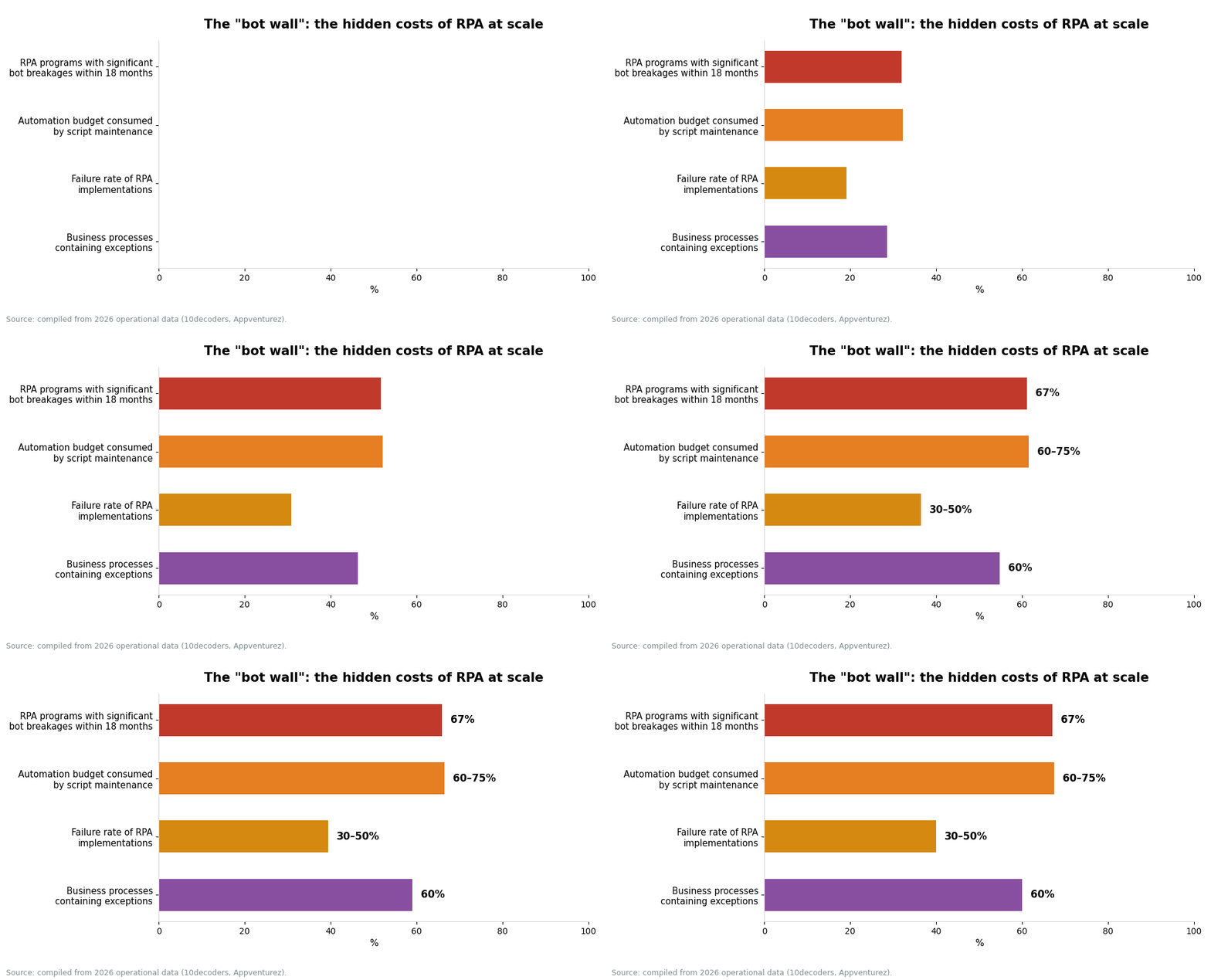
The problem emerges at scale. RPA scripts are anchored to pixel coordinates and rigid structures: it takes only a vendor updating a portal or moving a button for the bot to fail abruptly. The 2026 operational data is blunt:
- 67% of RPA programs suffer significant bot breakages within the first 18 months.
- Between 60% and 75% of the automation budget is consumed maintaining existing scripts, not creating new value.
- Implementation failure rates range between 30% and 50%, with nearly half of companies reporting weekly disruptions.
- 60% of business processes contain exceptions RPA cannot resolve, limiting the truly automatable universe to barely 5% of total corporate volume.
Intelligent automation (IPA) emerged as a transitional patch: it adds OCR, computer vision, and natural language processing to ingest semi-structured documents. It broadens what data the system can read, but the workflow remains deterministic: faced with an ambiguous business judgment, it escalates to a human.
AI agents: cognitive autonomy and its numbers
An AI agent does not execute a command sequence: it is a goal-driven entity that perceives its environment, reasons about context, plans across multiple steps, and uses tools dynamically. Powered by language models acting as a reasoning engine, it understands the intent of the process rather than hunting for screen coordinates.
The figures that matter to the boardroom:
- They handle between 4 and 7 times more complex exceptions without human intervention than RPA.
- Replacing legacy RPA with multi-agent orchestration cuts Total Cost of Ownership by 40% within 24 months.
- Documented ROI is 8:1, versus 2:1 for conventional RPA.
- The agent market projects nearly 50% year-over-year growth, toward $52.6–57 billion by 2030, while RPA shows signs of stagnation.

The fine print: the inference paradox
Autonomy carries a cost Gartner has dubbed the "inference paradox": even though the price per token has fallen 90%, an agentic workflow consumes between 5 and 30 times more tokens than a conventional bot, because the agent reasons, plans, self-corrects, and synthesizes in iterative loops. The result: inference cost per enterprise workflow will increase more than fivefold through 2028 if the architecture is not governed.
The dominant answer in 2026 is inference tiering with Small Language Models (SLMs): fleets of compact models running on private infrastructure absorb 85–90% of routine cognitive work (classifying, extracting, routing), and only the 10–15% of truly ambiguous cases fall back to frontier models in the cloud. This difficulty-based routing has been shown to cut inference spend by more than 70%, while preserving data privacy in regulated sectors.

The six decision criteria
The leading cause of poor ROI in the 58% of failed agentic implementations is over-engineering: deploying costly agents for simple algorithmic tasks. Before deciding, classify each process against these six criteria:
| # | Criterion | Choose RPA when… | Choose AI agents when… |
|---|---|---|---|
| 1 | Process structure | Invariable "if-then" rules | Business judgment and context |
| 2 | Exception volume | Below 5% | Above 15% |
| 3 | Data morphology | Structured (CSV, static APIs) | Emails, PDFs, images, voice |
| 4 | Environment stability | Interfaces change less than twice a year | Fluid environments, shifting regulation |
| 5 | Audit requirements | Millisecond-level algorithmic traceability (SOX) | Reasoning-based audit trail |
| 6 | Human-in-the-loop | Straight-through processing, no supervision | Human confirmation for high-risk actions |
A process matching four or more characteristics from the RPA column should be automated traditionally; if the agentic column dominates, AI is mandatory.
Governance: the risk that cannot be delegated
Granting autonomy demands hardened controls. 80% of organizations admit their AI agents have taken actions outside their stipulated scope, from unauthorized access to accidental credential disclosure. The new OWASP Top 10 for Agentic Applications (2026) identifies vectors such as goal hijacking via indirect injection, excessive permission abuse, cascading failures across agents, and long-term memory poisoning.
The minimum viable posture: dedicated non-human identities, immutable reasoning logs, control gateways over the MCP standard (Model Context Protocol, the connectivity layer universally adopted in 2026), Zero Trust principles, and human-in-the-loop thresholds for every high-risk action.
The hybrid architecture: agentic brain, robotic hands
IT leaders have abandoned the dichotomy. The consolidated paradigm — known as BOAT (Business Orchestration and Automation Technologies) — comes down to one principle: AI agents are the brain; RPA, the hands.
The multi-agent cognitive layer interprets context, absorbs format variability, resolves exceptions, and interacts with users. Once the data is clean, it hands it off to RPA bots that inject the information into legacy systems without APIs, at a fraction of the cost and with full traceability. The agents thus shield the bots from the volatility that used to break them. Documented results: process cycles compressed by up to 45% and combined savings neither technology achieves alone.
Real-world cases confirm it: in healthcare, prior authorization of procedures dropped from 20–25 minutes of specialized human work to under 4 minutes with multi-agent pipelines over electronic health records, meeting HIPAA through SLMs on private cloud. In banking and logistics, agents execute reconciliations and risk audits in real time, delegating the final transactional insertion to RPA.
To dive deeper into how automation applies to your organization, see our guides on intelligent AI automation for SMBs and why AI-first companies are winning. The official Model Context Protocol specification is available at modelcontextprotocol.io.
The essentials for the boardroom
-
RPA has hit its ceiling
99.9% accuracy and negligible per-transaction costs, but 60–75% of the budget goes to maintenance and only 5% of corporate work is fully automatable with rigid rules.
-
Agents multiply ROI — they don't guarantee it
8:1 ROI versus RPA's 2:1 and a 40% TCO reduction within 24 months, but 58% of failed implementations stem from over-engineering: expensive agents for simple tasks.
-
The inference paradox is real
An agentic workflow consumes 5–30 times more tokens than a bot. Without tiering to local SLMs (which absorb 85–90% of routine work and cut inference spend by 70%), costs multiply fivefold by 2028.
-
Six criteria, not intuition
Process structure, exception rate, data type, environment stability, audit requirements, and human-in-the-loop thresholds objectively determine which technology fits each process.
-
Governance is not optional
80% of organizations report agents acting out of scope. OWASP 2026 mandates non-human identities, immutable logs, Zero Trust, and human oversight of high-risk actions.
-
The hybrid architecture wins
Agents as the brain (interpreting, deciding, resolving exceptions) and RPA as the hands (executing on legacy systems): cycles compressed by up to 45% and maximum ROI protection.